
How to get started
This page provides information and resources to help persons with disabilities get started with physical activity, with guidance for different fitness levels and disability profiles.
Last updated on 20 July 2026
Singapore Physical Activity Guidelines (SPAG)
Whether you've not exercised in a while or are already fairly active, there is always a place to start and go further. Research has shown that physical activity can significantly improve the quality of life for persons with disabilities (PWDs).
Jointly developed by the Health Promotion Board and SportSG, the Singapore Physical Activity Guidelines (SPAG) (opens in new tab) states that regular physical activity can benefit PWDs in three key areas:
Physical Function - Improves motor symptoms, functional mobility and performance, endurance and overall movement.
Mental Health - Improved functional independence and ability improves the confidence and mental health of individuals.
Cognitive Function - Improves memory, attention, and social cognition.
Below is an infographic of the Singapore Physical Activity Guidelines for Persons with Disabilities. Persons with visual impairment may access a text-based version of the infographic below the image.
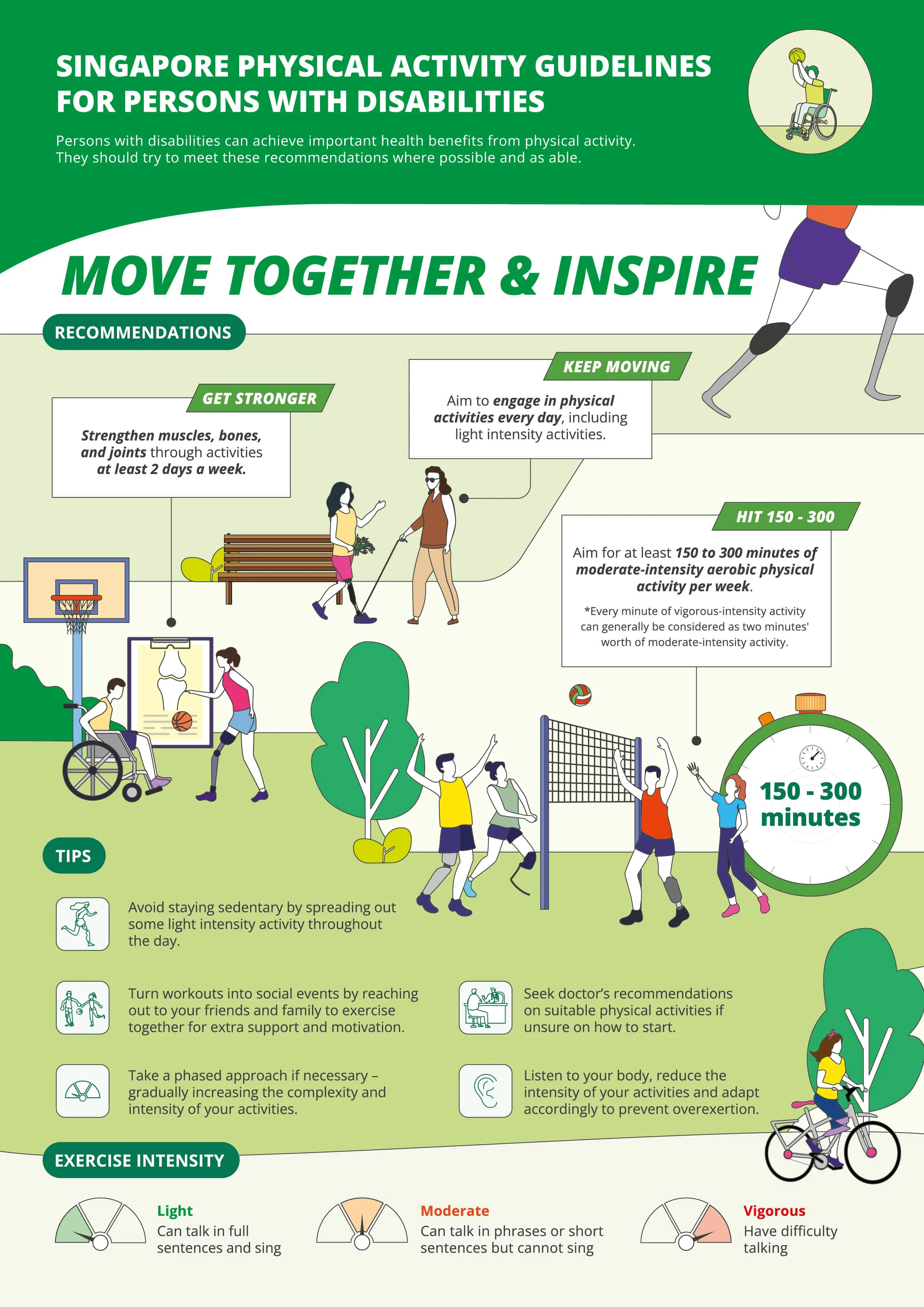
Singapore Physical Activity Guidelines for Persons with Disabilities, jointly developed by the Health Promotion Board and SportSG.
Text-based Version of the Singapore Physical Activity Guidelines for Persons with Disabilities Poster
This poster is about the Singapore Physical Activity Guidelines for Persons with Disabilities. It explains that persons with disabilities can achieve important health benefits from physical activity, and they should try to meet the recommendations where possible and as able. The main message of the poster is "Move Together & Inspire."
The poster gives three recommendations:
Get Stronger: Strengthen muscles, bones and joints through activities at least 2 days a week.
Keep Moving: Aim to engage in physical activities every day, including light intensity activities.
HIT 150 - 300: Aim for at least 150 to 300 minutes of moderate-intensity aerobic physical activity per week. Every minute of vigorous-intensity activity can generally be considered as two minutes' worth of moderate-intensity activity.
The poster also includes five tips:
Avoid staying sedentary by spreading out some light intensity activity throughout the day.
Turn workouts into social events by reaching out to your friends and family to exercise together for extra support and motivation.
Take a phased approach if necessary, gradually increasing the complexity and intensity of your activities.
Seek doctor's recommendations on suitable physical activities if unsure on how to start.
Listen to your body, reduce the intensity of your activities and adapt accordingly to prevent overexertion.
The poster explains exercise intensity in three levels:
Light: Can talk in full sentences and sing.
Moderate: Can talk in phrases or short sentences but cannot sing.
Vigorous: Have difficulty talking.
Just Starting Out
If you have been inactive for a while, there is no pressure to dive straight into sports. Here are some ways you can consider getting started safely and progressively.
Try These:
Work out at home
Join a gym orientation for persons with disabilities
Explore low-impact or adaptive sports
Work out at home
Starting at home is a great way to build confidence and ease into an active lifestyle. Begin with basic level exercises where there are demonstrations and instructions to guide you.
Join a gym orientation for persons with disabilities
Our gym orientation programme is a great way to build confidence before stepping into the gym on your own. A fitness instructor will guide you through the layout, equipment and accessible amenities.
Visit our gym orientation page for more information. (opens in new tab)
Explore low-impact or adaptive sports
Boccia and lawn bowls are great examples of low-impact sports that lets one experience the thrill of competition while easing into para sports. Alternatively, sports such as badminton can have their rules and equipment adapted to be enjoyed at a slower pace, for example, by lowering the net to allow for easier play and using balloons instead of shuttlecocks. The following resources are useful guides for inclusive sport activities:
If you are unsure which sports suit your needs, a designated Social Service Agency is a good place to start. For example, persons with visual impairment can contact Singapore Association of the Visually Handicapped, while persons with autism can look into activities offered by the Autism Association.
Level Up
Feeling stronger and more confident? Here are some ways to challenge yourself further and build on your progress.
Try these:
Challenge yourself with standard and advanced exercises
Find a sport you enjoy and train regularly
Challenge yourself with standard and advanced exercises
If you are feeling stronger and more confident, try progressing to the standard and advanced exercises to continue building your strength and endurance. If you feel any discomfort or pain, listen to your body and stop.
Find a sport you enjoy and train regularly
A great way to start training regularly is to find a structured sport programme that suits you. Discover programmes offered by SportSG, SDSC, Special Olympics and other providers.
To find a sport, you can start by searching by sport or programme provider:
Unlock Your Potential
Feeling ready to compete? There are various competitive pathways available to help you take that next step.
Try These:
Find local competitions to join.
Explore competitive pathways available.
Find local competitions to join
Ready to put your skills to the test? Joining a local competition is a great way to take your first step into competitive sport.
For example, Pesta Sukan is an annual event to get started with competitive para sport as it covers a wide range of sports. For other competitions and upcoming events, you can reach out to Singapore Disability Sports Council (SDSC) (opens in new tab).
Explore competitive pathways available
If you have been active and feel ready to pursue your sport at a competitive level, you can explore para-athlete pathways through the Singapore Disability Sports Council (SDSC). (opens in new tab) Additionally, you can refer to the sports recognised by the International Paralympic Committee that have a pathway to higher performance.
If you are d/Deaf or Hard of Hearing, you can contact the Singapore Association for the Deaf (SADeaf) (opens in new tab) or Deaf Sport Association (DSA) (opens in new tab) to find out about pathways to the Deaflympics.
Get In Touch
If you have any questions or would like to find out more about the programmes and pathways available to your disability profile, reach us via the form or email below and we will get back to you accordingly.